
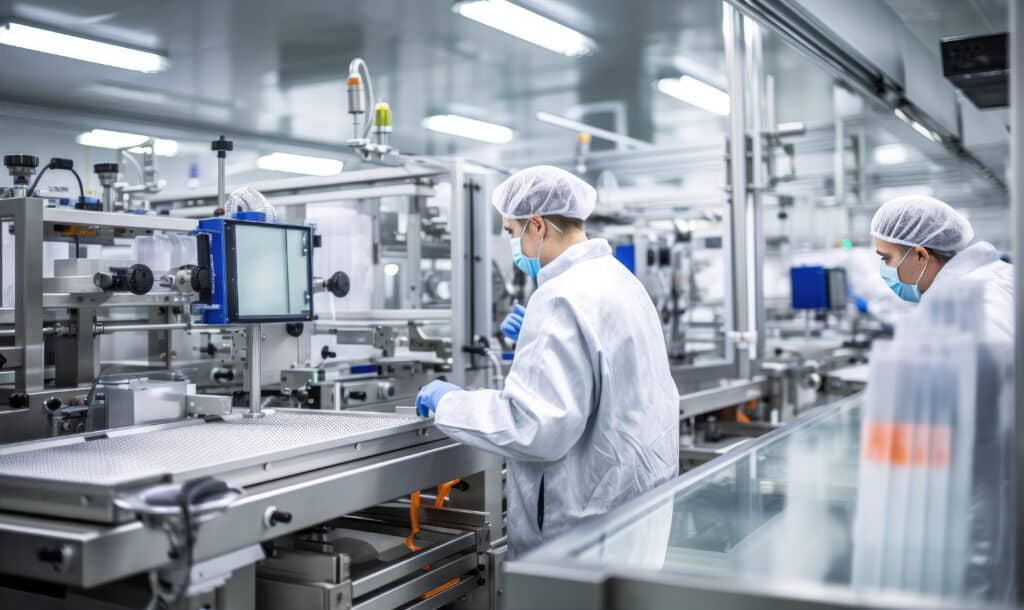
Our client, a major player in the pharmaceutical sector, entrusted B2C Engineering with the development of a solvent evaporation unit integrated into its production line. The main objective was to recover the solvent, a mixture of ethanol and heptane resulting from the synthesis of the product via Nautamix, and to recover the enantiomer from the separation of the charge.
B2C Engineering covered all stages of the project, from detailed design to start-up support: drafting PCS7 design documentation, development under PCS7 v8, management of recipes with SIMATIC Batch, FAT tests, on-site loading and functional validation, as well as training for operators and maintenance teams.
The PCS7 architecture deployed includes a master station and a slave station, two master servers and two WinCC slave servers, two web servers, 34 operator stations and 23 PLCs distributed between two pairs of servers. This configuration ensures reliability, redundancy and complete supervision of the industrial process.
Thanks to this intervention, the customer has been able to significantly improve the efficiency of its process, while benefiting from optimised ergonomics in its control/command system. The solution now ensures reliable and scalable operation, combining both performance and operational safety.
📥 Download this case study to discover how B2C Engineering developed and optimised an industrial solvent evaporation unit, improving process efficiency and reliability.